
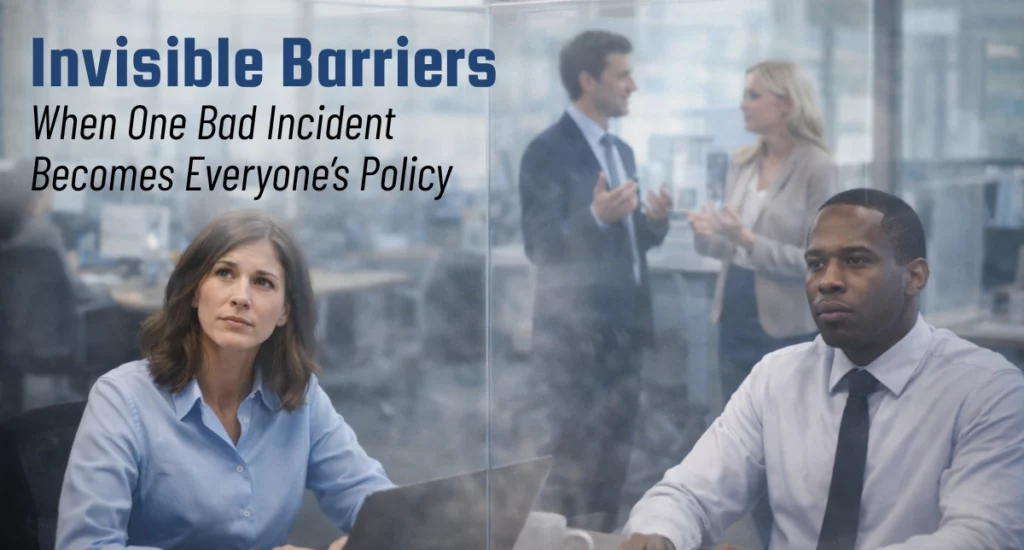
Invisible Barriers: When One Bad Incident Becomes Everyone's Policy
When Leadership Avoids the Hard Conversation
In my work with organizations across the country, I see a consistent pattern in employee relations challenges: Leaders are often more comfortable writing a rule than having a direct conversation. Why? Because policies feel safer. They feel neutral. They feel like they remove the risk of being “too personal” or “too subjective.” But here’s the truth: When leaders avoid addressing individual behavior directly, they shift the burden to everyone else. Instead of one employee being held accountable, the entire workforce is now governed by a new restriction—often solving a problem that never existed for most. And employees notice. They may not say it out loud, but they know:- Why the policy was created
- Who it was created for
- And that they are now paying the price for it
How Workplace Policies Become Invisible Barriers to Inclusion
Not all barriers in the workplace are intentional. In fact, some of the most impactful ones are created quietly, through policies that seem reasonable on paper but operate very differently in practice. These policies can:- Limit flexibility for employees with unique circumstances
- Create unnecessary hurdles for groups of employees who were never the issue
- Apply broad restrictions to solve narrow problems
The Shift from Flexibility to Rigid Workplace Policy
Here’s the part leaders often don’t anticipate: The moment you turn a situation into a policy, you lose discretion. What could have been handled thoughtfully—case by case—now becomes something that must be applied consistently. And consistency, while important, can become a liability when the policy itself doesn’t account for real-world differences. So now leaders face a difficult choice:- Enforce the policy strictly—even when it doesn’t fit the situation
- Or make exceptions—and risk being seen as inconsistent or unfair
When Good Intentions Lead to Compliance Risk
This is where things move from frustrating… to legally significant. Under Title VII of the Civil Rights Act of 1964, policies that appear neutral can still violate the law if they disproportionately impact certain groups and are not job-related or necessary for business operations. Let’s connect the dots:- A policy created to address one employee’s behavior
- Applied broadly to everyone
- Enforced inconsistently (because it doesn’t always make sense)
- Resulting in some employees being disproportionately affected
What Employees Experience (Even If Leaders Don’t See It)
When policies are created this way, employees often experience:- Loss of trust (“Why are we all being treated like this?”)
- Perceived unfairness (“This doesn’t apply to most of us.”)
- Reduced engagement (“Leadership isn’t addressing real issues.”)
- Increased complaints (because policies feel disconnected from reality)
A Different Leadership Approach to Workplace Policy
At Amediate, we spend a lot of time helping leaders build the confidence to do what policies can’t: Address issues directly, fairly, and thoughtfully. Before creating a policy, I often ask leaders to pause and consider:- Is this a pattern, or a one-time incident?
- Does this require a system-wide solution, or a targeted conversation?
- What problem are we actually trying to solve?
- And who might be impacted by this decision—intentionally or not?
Practical Shifts Leaders Can Make to Avoid Invisible Barriers
If this sounds familiar, here are a few ways to interrupt the cycle:- Address behavior at the source. Have the conversation. Set expectations. Hold individuals accountable.
- Use policies for patterns, not exceptions. Policies should respond to recurring, organization-wide risks—not isolated incidents.
- Allow room for reasonable discretion where appropriate. SHRM’s policy development resources offer helpful frameworks.
- Audit policies for unintended impact. Ask: Who might this affect differently? Who could be disadvantaged?
- Train leaders on employee relations—not just compliance. Policies don’t replace leadership skills. They should support it.
Final Thought: Not Everything Needs a Rule
The workplace was never meant to be managed entirely by policy.
It was meant to be led.
And when we rely too heavily on rules to solve people’s problems, we often create new problems—ones that are harder to see, harder to fix, and sometimes, harder to defend.
Invisible barriers don’t announce themselves.
They show up in patterns, in frustration, and in complaints that seem to come “out of nowhere.”
But when you trace them back, they often lead to a familiar place:
A moment where leadership chose policy… instead of conversation.
If we want fair workplaces—not just compliant ones—we have to be willing to do the harder work.
And that starts by asking:
Are we solving the right problem—or just writing it into policy?
Frequently Asked Questions
What are invisible barriers in the workplace?
Invisible barriers are workplace policies or practices that appear neutral on paper but create unintended obstacles for certain groups of employees. They often result from well-meaning decisions that were never designed with the full workforce in mind.
What is disparate impact?
Disparate impact occurs when a policy or practice that appears neutral disproportionately affects a protected group, even without discriminatory intent. Under Title VII, such policies can violate the law if they are not job-related or necessary for business operations.
How can leaders avoid creating invisible barriers?
Leaders can avoid creating invisible barriers by addressing individual behavior directly, using policies only for recurring patterns, building flexibility into policy language, and auditing existing policies for unintended impact on different employee groups.
Why do leaders create policies instead of having direct conversations?
Leaders often prefer policies because they feel safer, more neutral, and less personal than direct conversations. However, this approach shifts the burden of one person’s behavior onto the entire workforce and can create compliance risks.

About the Author
Sharon E Harrington, MA, CPTD, is the founder of Amediate LLC and a workplace communication expert with nearly 30 years of experience. As an EEO Investigator and Certified Professional in Talent Development, she helps organizations navigate complex workplace dynamics and build harmonious professional environments through her innovative "Leadership for the Learning Organization" program.
Learn more about Sharon's work → | Connect on LinkedIn