
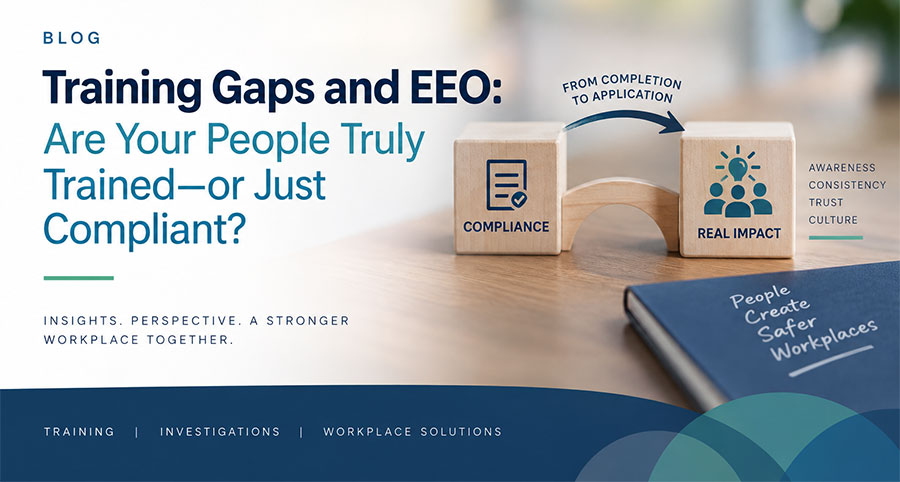
Training Gaps and EEO: Are Your People Truly Trained—or Just Compliant?
Organizations devote considerable time and resources to workplace training. Employees complete required courses, attendance is recorded, certificates are issued, and another compliance obligation is checked off the list. But one of the most overlooked risks is the connection between training gaps and EEO exposure—because completion does not necessarily mean learning occurred. An employee may have attended harassment-prevention training yet still feel unprepared to recognize subtle misconduct. A supervisor may know that retaliation is prohibited but fail to understand how everyday management decisions can appear retaliatory. An HR professional may have completed investigator training yet remain uncertain about how to scope an allegation, assess credibility, or determine whether the investigative record is complete. The more important question, therefore, is not simply “Did our employees complete the training?” It is: Can they consistently apply what they learned when it matters?Compliance Is a Starting Point, Not the Goal
Compliance training serves an essential purpose. It informs employees of their responsibilities, communicates organizational expectations, and demonstrates that the organization has taken steps to prevent and address workplace misconduct. But training designed primarily to satisfy a requirement may have limited influence on workplace behavior. Employees can click through an online module, answer a few questions correctly, and still be unsure about what to do when they encounter an actual workplace concern. Effective training should move people beyond awareness to application. Employees should be able to recognize the issue, understand their role, and respond in a manner consistent with the organization’s policies and values. That distinction is especially important in EEO-related matters. The way a supervisor receives a complaint, the questions an HR professional asks, the records an investigator seeks, and the organization’s response to an employee’s concern can all affect whether people trust the process. The law may set the minimum standard, but organizational trust is built on what employees repeatedly experience.Employees Notice Inconsistency in EEO Training
Employees do not judge an organization’s commitment to fairness solely by reading its policies. They watch what happens when someone raises a concern. These are the everyday moments where training gaps and EEO risk quietly intersect. They notice whether:- one manager takes a complaint seriously while another minimizes it;
- similar conduct receives different responses across departments;
- employees are told to report concerns but encounter silence after doing so;
- investigators follow different processes depending on who handles the matter; or
- organizational values are emphasized in training but are not reflected in daily decisions.

Training Should Connect to the Organizational Mission
Training is more meaningful when employees can see how it supports the organization’s broader purpose. An EEO course should not feel disconnected from leadership training, performance management, employee relations, customer service, or the organization’s stated values. Each learning experience should reinforce a consistent message about how people are expected to collaborate and how decisions are made. If an organization’s mission emphasizes integrity, respect, accountability, service, or inclusion, its training should help employees translate those values into workplace behavior. For example:- What does integrity require when a manager receives an uncomfortable complaint?
- What does accountability look like when a high-performing employee violates policy?
- How is respect demonstrated during a difficult investigative interview?
- How does fairness influence the collection and evaluation of evidence?
- What does inclusion mean when an employee raises a perspective that challenges the majority view?
Consistency Requires More Than Repetition
Consistent training does not mean presenting the same slides every year. It means reinforcing a common set of expectations over time and helping employees apply them to new situations. Closing training gaps and EEO exposure requires ongoing reinforcement, not a single annual event. Workplaces change. Teams change. Employees move into supervisory roles. New professionals assume responsibility for handling complaints and conducting investigations. Emerging technologies, shifting workforce expectations, and new workplace scenarios raise questions that may not have been addressed in earlier training. For that reason, training should be viewed as an ongoing organizational practice rather than a single event. Consistency can be strengthened through:- common terminology and decision-making frameworks;
- realistic scenarios based on issues employees may encounter;
- opportunities to practice difficult conversations;
- periodic refreshers that build on earlier learning;
- discussion across departments or locations;
- tools employees can use after the training ends; and
- leadership behavior that reinforces the same expectations taught in class.
How Do You Know Whether EEO Training Is Effective?
Quick answer: Attendance records confirm training occurred, but not that employees can apply it. Effective training shows up when employees can explain their responsibilities in their own words, apply concepts to realistic scenarios, respond consistently, know where to get help, and demonstrate changed behavior over time—not just a completed course. Organizations seeking to evaluate effectiveness should look beyond participant satisfaction and assess whether the training has influenced knowledge, confidence, behavior, and organizational outcomes. Useful questions include:Can employees explain what they are expected to do?
Participants should be able to describe their responsibilities in their own words—not merely repeat language from a slide.Can they apply the concepts to realistic situations?
Scenarios, case discussions, role-plays, and practical exercises reveal whether employees can recognize and respond to issues when the facts are less obvious.Are managers responding consistently?
The organization should examine whether concerns are being documented, elevated, and addressed in a reasonably consistent manner.Do employees know where to go for help?
Training is less effective if employees leave without understanding how to report concerns or where to obtain guidance.Are trained professionals using a common framework?
HR professionals and investigators should share an understanding of how to identify allegations, gather relevant evidence, evaluate conflicting information, and document their work.Does behavior change after the training?
Follow-up conversations, quality reviews, employee feedback, complaint trends, and observations from HR and leadership can provide a fuller picture than end-of-course evaluations alone.Is learning reinforced?
Even strong training will lose its influence if the organization never revisits the concepts or if leadership practices contradict what employees were taught. Training effectiveness is not always reflected in a reduction in complaints. In some cases, an initial increase in reporting may indicate that employees better understand their rights and have greater confidence in the organization’s process. The goal is not the absence of concerns. It is the organization’s ability to recognize, receive, and respond to those concerns fairly and effectively.From Required Training to a Trusted Culture
Employees are more likely to believe an organization’s commitment to EEO when they can see consistency between its message and its actions. Addressing training gaps and EEO readiness together is how required training becomes a trusted culture. Trust develops when the organization’s policies, training, leadership decisions, complaint processes, and investigative practices support one another. It grows when employees understand what to expect and see that similar standards are applied across roles and departments. That kind of culture cannot be created by one annual course. It requires intentional alignment and reinforcement. Reputable resources such as SHRM and the U.S. Department of Labor similarly emphasize that ongoing, applied training is central to effective workplace compliance. At Amediate, we value bringing teams together to work through realistic workplace situations, examine different approaches, and develop a shared standard—particularly among professionals responsible for receiving complaints and conducting investigations. Training a team together can help an organization strengthen consistency while preserving the professional judgment each matter requires. The question for organizations this September is not merely whether employees have completed the required training. The better question is:Does the way we train our people help them understand our values, apply a consistent standard, and give employees a reason to trust our words?When the answer is yes, training becomes more than a compliance activity. It becomes part of the culture employees experience—and believe.
Ready to move your team beyond compliance? Amediate’s
team-based
investigator training helps your professionals build a shared standard they
can apply with confidence.
Schedule a 15-Minute Consultation →
